
Planning Your Florence Trip: Renaissance Art and the Crowds
How to plan a Florence trip that goes beyond the tourist queue for the Uffizi — covering the best time to visit, where to stay, which lesser-known churches rival the famous ones, and how a local guide transforms the city's art into lived experience.
Read the full guideUpdated · 11 min read
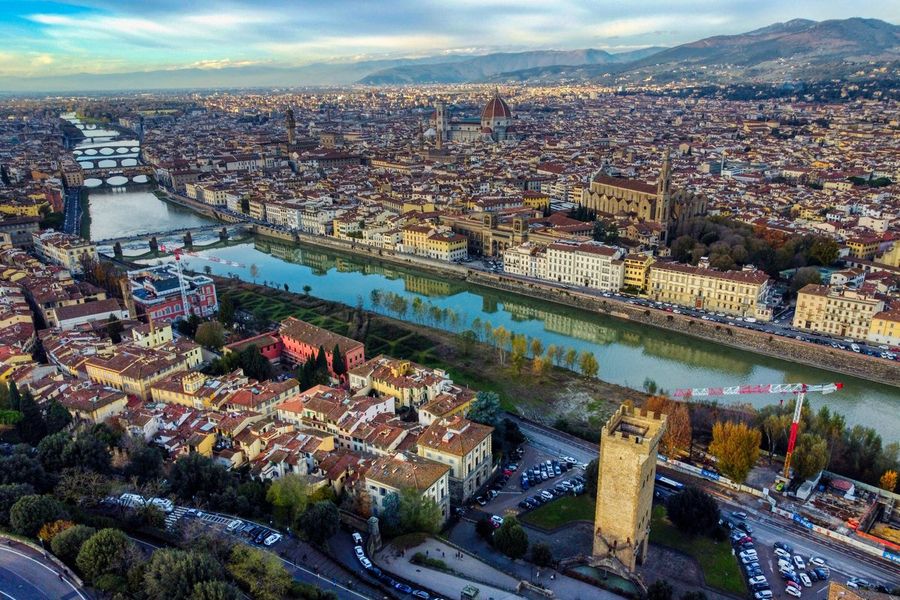
Plan Florence around its compact historic centre and its crowds. Visit in April to early June or September to October for mild weather and lighter lines, book Uffizi and Accademia timed tickets weeks ahead, and go deep rather than broad — a few rooms and lesser-known churches reward far more than checklists.
Florence is one of the world's most visited cities and one of its most rewarding — two facts that are in constant tension. The concentration of art, architecture, and urban beauty in a relatively compact historic centre means that peak-season Florence can feel more like queuing management than travel. With the right approach, however, you can move through the same city with ease while most visitors are standing in lines.
When is the best time to visit Florence?
The honest answer is April to early June or September to October, when mild temperatures meet manageable crowds and a full cultural programme. July and August bring 35°C heat and hours-long queues without pre-booking. November to February is underrated: the cold keeps casual visitors away and the major museums are at their calmest.
The honest answer is April to early June or September to October. These shoulder periods combine mild temperatures with manageable crowds and the full cultural programme running — exhibitions, concerts, local festivals.
July and August are Florence at its most challenging: temperatures regularly exceed 35°C, queues at the Uffizi Gallery and Accademia stretch for hours without pre-booking, and the Arno's heat radiates off the stone streets long after sunset. If summer is your only option, book everything in advance, start your museum visits at opening time, and retreat indoors between noon and 5 p.m.
November to February is underrated. The cold (5–12°C) keeps most casual visitors away; the major museums are quieter than at any other time of year; and the city's restaurants and markets operate at their most local. December brings Christmas markets around the Piazza della Repubblica and the city's Christmas lighting programme, which tends toward understated elegance compared to northern European counterparts.
Where should you stay in Florence?
Florence's historic centre is small enough that most visitors stay within it, the key choice being north or south of the Arno. North puts the Uffizi, Duomo, and Accademia on foot but is tourist-saturated. The quieter Oltrarno offers neighbourhood restaurants and the Pitti Palace, with San Niccolò the most atmospheric corner.
Florence's historic centre is small enough that most visitors choose to stay within it. The key distinction is between staying north or south of the Arno.
North of the Arno (the Centro Storico, San Lorenzo, and Santa Croce neighbourhoods) puts you within walking distance of the Uffizi, the Duomo, and the Accademia. It is the most convenient base but also the most tourist-saturated, particularly in summer.
The Oltrarno (literally "beyond the Arno," on the south bank) has a different feel — quieter, more residential, with excellent neighbourhood restaurants and the Pitti Palace and Boboli Gardens within easy reach. Crossing the Ponte Vecchio or any of the other central bridges is a five-to-ten-minute walk to the main sights. For travellers who want the most atmospheric experience of the city alongside strong access to the major monuments, this is often the best choice.
San Niccolò at the eastern end of the Oltrarno is particularly appealing — a neighbourhood where locals still genuinely live alongside the tourists and where the streets above the Piazzale Michelangelo offer some of the best elevated views of the city.
Why is advance booking non-negotiable?
For the Uffizi and Accademia, advance booking is practically mandatory, not a convenience. Both use timed-entry systems, and walk-up availability in peak season is often zero. Book through the official uffizi.it several weeks ahead for summer and at least a week ahead even in shoulder season. Palazzo Pitti and the Bargello are fallbacks.
For Florence, advance ticket booking is not a convenience — it is practically mandatory for the Uffizi and Accademia. Both institutions operate timed-entry systems, and walk-up availability in peak season is often zero. Book through the official Uffizi booking system (uffizi.it) several weeks in advance for summer visits and at least a week ahead even in shoulder season.
If you haven't pre-booked and find yourself without tickets, Palazzo Pitti and the Bargello are the most prestigious alternatives with reliably shorter queues, and both house first-rank collections.
How should you approach the Uffizi?
The Uffizi holds arguably the world's greatest Italian Renaissance painting — Botticelli's Primavera and Birth of Venus, Giotto, Michelangelo, Caravaggio, and Raphael. Trying to see everything exhausts most visitors, so choose two or three rooms and give them full attention. Rooms 10–14 and Room 34 alone justify the visit; allow 2–3 hours minimum.
The Uffizi Gallery is arguably the most important collection of Italian Renaissance painting in the world — Botticelli's Primavera and Birth of Venus, Giotto's Maesta, Michelangelo, Caravaggio, and Raphael, all in one building. The problem is that the ambition of seeing everything leads most visitors to exhaust themselves seeing nothing deeply.
A better approach: identify two or three rooms and give them your full attention. Room 10–14 (Botticelli) and Room 34 (Michelangelo's Holy Family Tondo) alone justify the visit. The upper corridor views of the Ponte Vecchio and the Arno are free and stunning regardless of the queues downstairs.
Allow 2–3 hours minimum; 4–5 hours for anyone seriously engaged with the collection.
What should you know about the Accademia and Michelangelo's David?
The Galleria dell'Accademia exists essentially to house Michelangelo's David, whose 5.17-metre scale surprises nearly every visitor. Less celebrated is the hall of unfinished Prisoners leading to it, where figures emerge from and remain held within the stone. These sculptures rank among the most significant in Western art, yet many rush past them.
The Galleria dell'Accademia exists essentially to house Michelangelo's David — one of the most discussed works of art in existence and one that surprises virtually every visitor by its scale (5.17 metres). What is less well known is the hall of unfinished Prisoners (Prigioni) leading to the David, in which Michelangelo's working method is made visible: figures emerging from and being held within stone rather than chiselled free of it. These are among the most significant sculptures in Western art history and are often rushed through on the way to the David.
What lies beyond the famous sights?
Florence's lesser-known churches often yield the richest discoveries. The Cappella Brancacci in the Oltrarno holds Masaccio's 1424–25 frescoes, the great precursor to the Renaissance figure. San Miniato al Monte, an eleventh-century Romanesque church above Piazzale Michelangelo, offers Benedictine vespers at 5:30 p.m., while the Bargello has shorter queues than the Accademia.
Florence's lesser-known churches and institutions are where the most rewarding discoveries often happen. The Cappella Brancacci in the Santa Maria del Carmine church in the Oltrarno contains Masaccio's frescoes from 1424–25 — the most important precursor to the full Renaissance figure, with a naturalism that had not existed in Western art for a thousand years before him. Entry is timed, numbers limited, and the experience of standing in the small chapel before these works is extraordinary.
San Miniato al Monte above the Piazzale Michelangelo is a Romanesque church from the eleventh century with an inland marble facade and a quiet interior that most Uffizi visitors never see. The monastery adjacent to it still hosts Benedictine monks who sing vespers at 5:30 p.m. — one of the most peaceful experiences available in the city.
The Museo del Bargello houses the world's greatest collection of Italian Renaissance sculpture, including works by Donatello, Ghiberti, and Verrocchio, in a thirteenth-century palazzo that was Florence's first town hall and later a prison. It consistently has shorter queues than the Accademia despite the significance of its collection.
How does working with a local guide help?
Florence's art needs context most visitors can't absorb unaided: understanding the Medici banking system, the Byzantine scholars who arrived after Constantinople fell, and merchant-artist patronage transforms standing before a painting. Licensed art history guides offer themed tours; half-day private tours start around €120–180, small groups €25–45, and some unlock spaces closed to independents.
Florence's art requires context that cannot be absorbed in the time available to most visitors without guidance. Understanding why the Florentine Renaissance happened here and not somewhere else — the Medici banking system, the Byzantine scholarly tradition relocated to Florence after the fall of Constantinople, the specific patronage relationships between merchants and artists — transforms the experience of standing before a painting.
Licensed art history guides in Florence typically offer themed tours: early Renaissance, high Renaissance, Medici history, or the Oltrarno artisan tradition. Half-day private tours start around €120–180; small group tours (six to eight people maximum) run €25–45 per person. Booking through the Florence licensed guide association (guide-turistiche-toscane.it) ensures certified expertise.
The best guides will take you into spaces that require advance access — private palace courtyards, studios of working artisans in the Oltrarno leather trade — that are inaccessible to independent visitors.
What should you eat, and which markets matter?
Florence's traditional cooking is exceptional: bistecca alla Fiorentina from Chianina cattle, ribollita bread-and-vegetable soup, and lampredotto tripe sandwiches, the quintessential street food. The Mercato Centrale in San Lorenzo pairs an upstairs food hall with a genuine ground-floor produce market. For the best bistecca, reserve along Via dei Neri or in the Oltrarno.
Florence is not Italy's most adventurous food city but its traditional cooking is exceptional: bistecca alla Fiorentina (the T-bone steak from Chianina cattle), ribollita (bread and vegetable soup), lampredotto (tripe sandwich, the quintessential street food). The Mercato Centrale in San Lorenzo has an upstairs food hall with reliable quality; the ground-floor market is a genuine produce market used by local restaurateurs. The stalls along Via dell'Ariento outside are tourist-facing and should be approached accordingly.
For the best bistecca, make a reservation at one of the traditional restaurants along the Via dei Neri or in the Oltrarno — the cut is expensive (typically by weight, charged per 100 grams) but is one of the genuine culinary highlights of visiting Tuscany.
Which day trips are worth taking?
Three day trips reward the effort. Siena, 90 minutes by bus, preserved its medieval cityscape precisely because Florence eclipsed it, and its Palio horse race runs July 2 and August 16. San Gimignano, an hour away, keeps thirteen of its original medieval towers. The Chianti wine country suits a full-day guided tour.
Siena is 90 minutes by bus from Florence and offers a medieval cityscape that preserved its character precisely because it was economically eclipsed by Florence in the fourteenth century — the same civic competition that drove the Renaissance. The Palio horse race (July 2 and August 16) is one of Italy's most extraordinary civic rituals; visiting even outside race period is deeply rewarding.
San Gimignano (1 hour by bus) is the tower city — thirteen medieval towers survive from the original seventy-two, the result of wealthy families literally building taller than their rivals. Crowded in summer but still atmospheric.
The Chianti wine country between Florence and Siena is best explored by car or on a wine tour. Several Florence operators offer full-day guided Chianti tours that include winery visits, lunch, and time in a small hilltop village.
What's the practical summary?
A handful of rules capture it: book Uffizi and Accademia tickets weeks ahead rather than at the door, stay in the Oltrarno for character or Santa Croce for location, and give the Cappella Brancacci and Bargello more time than guidebooks suggest. Eat tripe once, and climb to San Miniato al Monte at sunset.
- Book Uffizi and Accademia tickets weeks in advance — do not plan to buy at the door
- Stay in the Oltrarno for character, or in Santa Croce for location
- Give the Cappella Brancacci and Bargello more time than the guidebook suggests
- Eat tripe at a lampredottaio stand at least once
- San Miniato al Monte at sunset justifies any amount of uphill walking
Florence is a city that repays depth over breadth. The visitor who spends three hours in the Uffizi and two hours in the Cappella Brancacci leaves with more than the one who checks off ten attractions in the same time. That is, arguably, the Renaissance lesson applied to tourism.
Frequently Asked Questions
Do I need to book the Uffizi and Accademia in advance?
Yes, absolutely. Both sell timed-entry tickets that should be reserved well ahead, especially in high season, to avoid queues that can otherwise exceed two hours.
When is the best time to visit Florence?
Spring and autumn offer the most pleasant weather and lighter crowds. Summer is hot and packed, while winter is quiet and the museums are at their calmest.
How long does it take to see Michelangelo's David?
The Accademia visit centres on the David and can be done in about an hour, so many visitors pair it with a nearby museum or church to make the most of their timed entry.
Is Florence walkable, or do I need transport?
Florence's historic centre is compact and best explored on foot, with the major sights within a fifteen-minute walk of each other. Buses are useful mainly for reaching Piazzale Michelangelo or the station.