
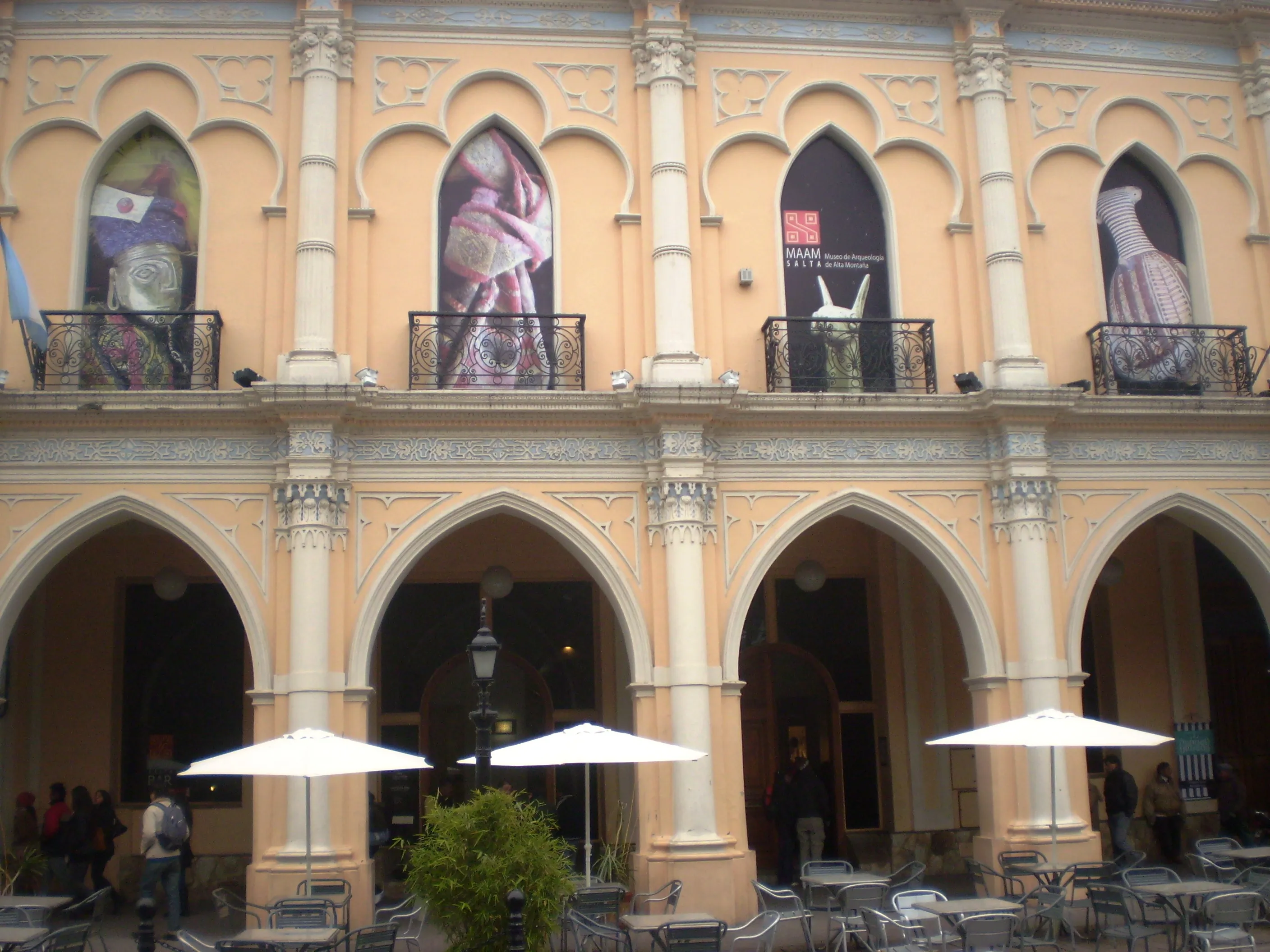
Collections Highlights
The Children of Llullaillaco are the unmissable core — three Inca children recovered from a 6,739-metre summit, with one rotated into the climate-controlled display capsule at a time. Each has a distinct story: the Doncella (Maiden), around fifteen, seated cross-legged with elaborately braided hair; el Niño (the boy), about seven, bound in textiles; and la Niña del Rayo (the Lightning Girl), around six, whose face and shoulder were scorched by a lightning strike that hit the burial long after her death.
Beyond the mummies, the grave-goods collection is extraordinary:
- Figurines — miniature human and llama statuettes of gold, silver, and red Spondylus shell, dressed in tiny woven garments and feather headdresses, buried as companions and offerings.
- Textiles — unku tunics, aksu dresses, and finely braided slings that show the technical mastery of Inca weaving.
- Ceremonial and everyday objects — pottery, sandals, coca bags, wooden cups, and moccasins that map daily and sacred life in the Andean highlands.
Two later additions round out the holdings: the Reina del Cerro mummy, looted from the Chuscha hill in the 1920s and eventually recovered for the museum, and the Teruel collection of objects and skeletal remains from the San Carlos department. Together they make the MAAM the definitive collection of Andean high-mountain archaeology — the same culture whose living descendants and ruined pucarás you meet up the road in the Quebrada de Humahuaca.
Guided Tours
The museum is small enough that guided interpretation makes an enormous difference. Spanish-language guided visits are typically offered free at scheduled times through the day — ask at the ticket desk for the next departure. An audio guide (a small extra fee) is available in several languages and is the easiest way for non-Spanish speakers to get full context.
For deeper or English-language guiding, the best option is to book a private guide through a Salta tour operator, who can wrap the MAAM into a walking tour of Plaza 9 de Julio, the cathedral, and the historic centre, or bookend it with the province's Andean excursions. Group tours move briskly through the mummy room because it is kept silent and dim, then linger over the grave goods, where most of the explanation happens.
- For solitude with the Doncella: arrive at opening and let the first guided group pass through ahead of you.
- For depth: a specialist guide can connect the capacocha rite to the Inca road system and the high shrines still dotting the Puna.
- For a full itinerary: many operators sell the museum as the cultural prologue to a multi-day northwest circuit taking in the Quebrada de Humahuaca and the Tren a las Nubes.
Museo de Arqueología de Alta Montaña (MAAM) timeline
-
Capacocha on Llullaillaco
Three children were taken to the 6,739-metre summit and offered in a capacocha rite, then frozen and preserved by the cold, dry summit air for roughly five centuries.
- 1920s
Reina del Cerro looted
A separate Inca mummy was dug illegally from the Chuscha hill in the Calchaquí valleys and passed through private hands for decades before reaching the museum.
- March 1999
Children of Llullaillaco found
An expedition led by anthropologist Johan Reinhard and archaeologist Constanza Ceruti recovered the three children and their grave goods near the volcano's summit.
-
MAAM inaugurated
The provincial government opened the museum on Plaza 9 de Julio expressly to conserve and display the find under scientific conditions.
-
First child put on show
After years of engineering, the low-temperature, low-oxygen display capsule was ready and the first mummy went on public view.
-
Sacrifice science published
Hair-chemistry analysis of the Maiden, published in PNAS, showed a rising intake of coca and alcohol in her final months, evidence she was progressively sedated.
When to Visit
The MAAM is generally open Tuesday to Sunday, roughly 11 AM to 7:30 PM, and closed on Mondays (hours shift slightly by season, so confirm on the day). Allow 90 minutes to 2 hours — longer if you take the audio guide and read the panels properly.
Best season: the dry Andean winter from June to September is Salta's high season — clear skies, cool comfortable days, and the museum makes a perfect indoor anchor while you acclimatise before heading to altitude. The month ratings above peak in exactly this window. Mid-morning on a weekday is the quietest time to arrive; weekend afternoons and the January–February domestic-holiday peak bring the longest queues, and the mummy gallery — kept dim and cool no matter the weather outside — can feel crowded once a tour group files in.
- Right after opening (11 AM) is best if you want unhurried, near-solitary time in the mummy room before the first guided groups arrive.
- Last entry is usually 30–60 minutes before closing; do not arrive at 7 PM expecting a full visit.
- Accessibility: the collection spreads over several floors of a historic building, so step-free access can be limited — travellers with reduced mobility should ask staff about the lift and the best route on arrival.
Because it is entirely indoor and climate-controlled, the MAAM is also the ideal rainy-day or arrival-day plan in a region where so much else — the Quebrada de Humahuaca drive, the Tren a las Nubes — depends on clear mountain weather.
Admission and Costs
General admission is around AR$8,000–12,000 (roughly US$8–12) for adults, with reduced rates for students, seniors, and children, and discounted or free entry for residents of Salta Province (often on a designated free day — ask at the desk). Prices are revised frequently because of Argentine inflation, so treat every figure here as approximate and check the current tariff on arrival.
- Audio guide: a few thousand pesos on top of admission, available in several languages and well worth it for non-Spanish speakers.
- Guided visits in Spanish: usually included with the ticket at set times through the day.
- Private English-language guiding booked through a Salta operator typically runs AR$20,000–40,000 (about US$20–40) on top of admission, and can be combined with a walking tour of the plaza.
Bring cash in pesos — card acceptance can be unreliable, and the small-denomination change needed for the audio guide or gift shop is easier with notes in hand.
The Case for a Guide
A good guide turns the MAAM from a striking but sombre display into one of the most illuminating hours in northern Argentina.
- The capacocha ceremony explained: Understanding why the children were sacrificed — as offerings to seal the bonds between the Inca state, the mountains, and the gods — transforms the experience from morbid curiosity into anthropology; a guide makes the ritual logic clear and humane
- Reading the grave goods: The miniature gold and Spondylus figurines, the textiles, and the feather work each carry symbolic meaning that is invisible without explanation; a guide decodes the iconography
- The science of preservation: Guides explain how altitude, cold, and low oxygen produced natural mummification, and why the display capsule had to be engineered to recreate summit conditions
- Ethical context: The exhibition is genuinely controversial — local indigenous groups object to displaying the children at all; a thoughtful guide presents this debate rather than glossing over it
- Connecting to the wider region: A guide ties the museum to the high-altitude shrines, the Tren a las Nubes route, and the Andean cultures still living in the quebradas, giving your whole Salta itinerary a backbone
Tips for Visitors
Go early in your Salta trip. Seeing the children and understanding the capacocha ceremony first makes everything else in the northwest — the mountain shrines, the Quebrada de Humahuaca, the Puna — far more meaningful, and the fully indoor visit doubles as a gentle acclimatisation day before you climb to altitude on the Tren a las Nubes.
- Take the audio guide or a guide. The panels are good, but the layered story of mountain worship and Inca statecraft rewards narration.
- Respect the room with the mummy. It is silent, dim, and treated almost as a memorial — no flash, no photos, and many visitors find it genuinely moving. Steady young children beforehand, or skip that gallery with them.
- Combine with the plaza. The MAAM faces Salta's Plaza 9 de Julio, ringed by cafés under colonial arcades, so pair your visit with lunch and a look at the cathedral and cabildo.
- Check which child is showing. The rotation means returning visitors may see a different mummy — the boy, the Doncella, or la Niña del Rayo — than last time.
- Buy the catalogue, not smuggled photos: the gift shop's official book reproduces the grave goods far better than a phone can through low display light.
Frequently Asked Questions
Why are the Llullaillaco mummies considered so significant?
The three children recovered from the Llullaillaco volcano in 1999 are widely regarded as the best-preserved mummies on Earth. Because they were buried at 6,739 metres in permanently frozen, oxygen-poor ground, they were never artificially embalmed — they simply froze. Internal organs, blood, skin, eyelashes, and even the contents of their stomachs survived intact, giving researchers an unmatched window into Inca capacocha sacrifice rituals carried out roughly 500 years ago. No other archaeological find has preserved human remains at this level of fidelity.
Are the mummies always on display, or do they rotate?
Only one of the three children is exhibited at any given time, rotated periodically to limit stress on each body. The chosen mummy rests inside a specially engineered low-temperature, low-oxygen display capsule that recreates the conditions of the volcano summit — the system took until 2007 to perfect. The other two children, plus the Reina del Cerro mummy, remain in controlled storage. This means repeat visitors often see a different child, and the museum's full collection of grave goods is always on view regardless of which mummy is showing.
How much time should I set aside for the MAAM?
Plan for about 90 minutes to two hours. The museum is compact — spread over a few floors of a historic building on Plaza 9 de Julio — but the displays are dense with context, and the room holding the mummy is deliberately dim and contemplative, which slows visitors down. Reading the panels on the capacocha ceremony, the textiles, and the gold and Spondylus figurines properly takes time. Rushing it misses the point.
Is photography allowed inside the museum?
Photography is not permitted in the gallery holding the mummy, both out of respect for the children and to protect the light-sensitive remains. Flash is banned throughout. Some other halls allow non-flash photos, but rules are posted and enforced by staff, so check at the entrance. The gift shop sells postcards and the official catalogue if you want images of the collection.
Where is the MAAM and how do I get there?
The museum sits on the western side of Plaza 9 de Julio, the main square of Salta, so it is an easy walk from almost any hotel in the compact colonial centre. From the bus terminal it is a flat ten-to-fifteen-minute stroll, or a very cheap remise (private car) ride; if you are driving in from the airport (about 10 km southwest), leave the car at a central car park, as the plaza streets are pedestrianised and metered. Pair the visit with the cathedral and cabildo on the same square, and use the museum as an acclimatisation stop early in your trip before heading up to the Tren a las Nubes or the Quebrada de Humahuaca.
Is the MAAM suitable for children, or is it too disturbing?
The centrepiece is the preserved body of a real child, and the mummy gallery is dim, silent, and treated almost as a memorial, so it can unsettle young or sensitive visitors. Older children and teenagers usually find it fascinating rather than frightening, especially with a guide to frame the capacocha story respectfully. Parents who would rather not take a small child into the mummy room can skip that single gallery and still see the figurines, textiles, and grave goods, which fill most of the museum and are genuinely engaging for all ages.