
Pena Palace timeline
-
A Hieronymite monastery crowns the peak
King Manuel I endows the Order of St. Jerome with a small monastery of Nossa Senhora da Pena on the summit, home to only a handful of monks.
-
The Great Lisbon Earthquake ruins the cloister
The quake topples the already-decaying monastery, though the chapel and its Renaissance alabaster altarpiece survive amid the rubble.
-
Ferdinand II buys the ruins
The artist-minded, German-born king consort acquires the monastery ruins and the surrounding hills as the stage for a Romantic retreat.
- 1842–1854
The Romantic palace rises
With the amateur architect Baron Wilhelm von Eschwege, Ferdinand fuses Moorish, Gothic, Manueline and Renaissance motifs into one painted silhouette, keeping the old convent as its core.
-
The Artist King dies
Ferdinand dies with the interiors and park still being refined; the palace passes to his second wife, Elise Hensler, Countess of Edla.
-
The state reclaims Pena
The Portuguese crown buys the palace back from the Countess of Edla, and after the 1910 republic it becomes a national monument and museum.
- 1990s
The faded façades regain their colour
After decades of grey weathering, Parques de Sintra restores the palace's original vivid red and ochre — the colours Ferdinand first chose.
-
UNESCO lists the Cultural Landscape of Sintra
Pena, its park, the neighbouring Moorish Castle and the town's palaces are inscribed together as the first European site in the Cultural Landscape category.
-
Voted a Wonder of Portugal
A nationwide public vote names Pena one of the Seven Wonders of Portugal, sealing its status as Sintra's signature image.
Notable Rooms
Behind the painted walls, the interiors are compact and easy to rush — which is exactly why they reward slowing down. The royal apartments are preserved much as Ferdinand II and Maria II left them, from the stucco-vaulted halls and cluttered private bedrooms to a cavernous kitchen still hung with gleaming copper pots stamped with the royal monogram. The former monastery's chapel anchors the oldest part of the building, its Renaissance alabaster-and-marble altarpiece — attributed to the sculptor Nicolau de Chanterene — surviving from the pre-earthquake convent. Overhead, the Arab Room dazzles with trompe-l'œil frescoes, and the cloister's azulejo tilework recalls the Hieronymite monks who once kept a spare, contemplative house on this same windswept summit.
Fortification History
Pena's ramparts, drawbridge, and studded gateways are theatrical rather than defensive — Ferdinand borrowed the vocabulary of a castle to stage a Romantic fantasy, not to withstand a siege. The set pieces worth hunting down:
- The Triton Gateway — a grimacing half-man, half-sea-creature crouched over a coral-encrusted arch, an allegory of the creation of the world guarding the way into the inner courtyards.
- The Queen's Terrace — the highest viewpoint, with panoramas across Sintra's forests to the Atlantic and, on a clear day, back to the Moorish Castle on the neighbouring crag.
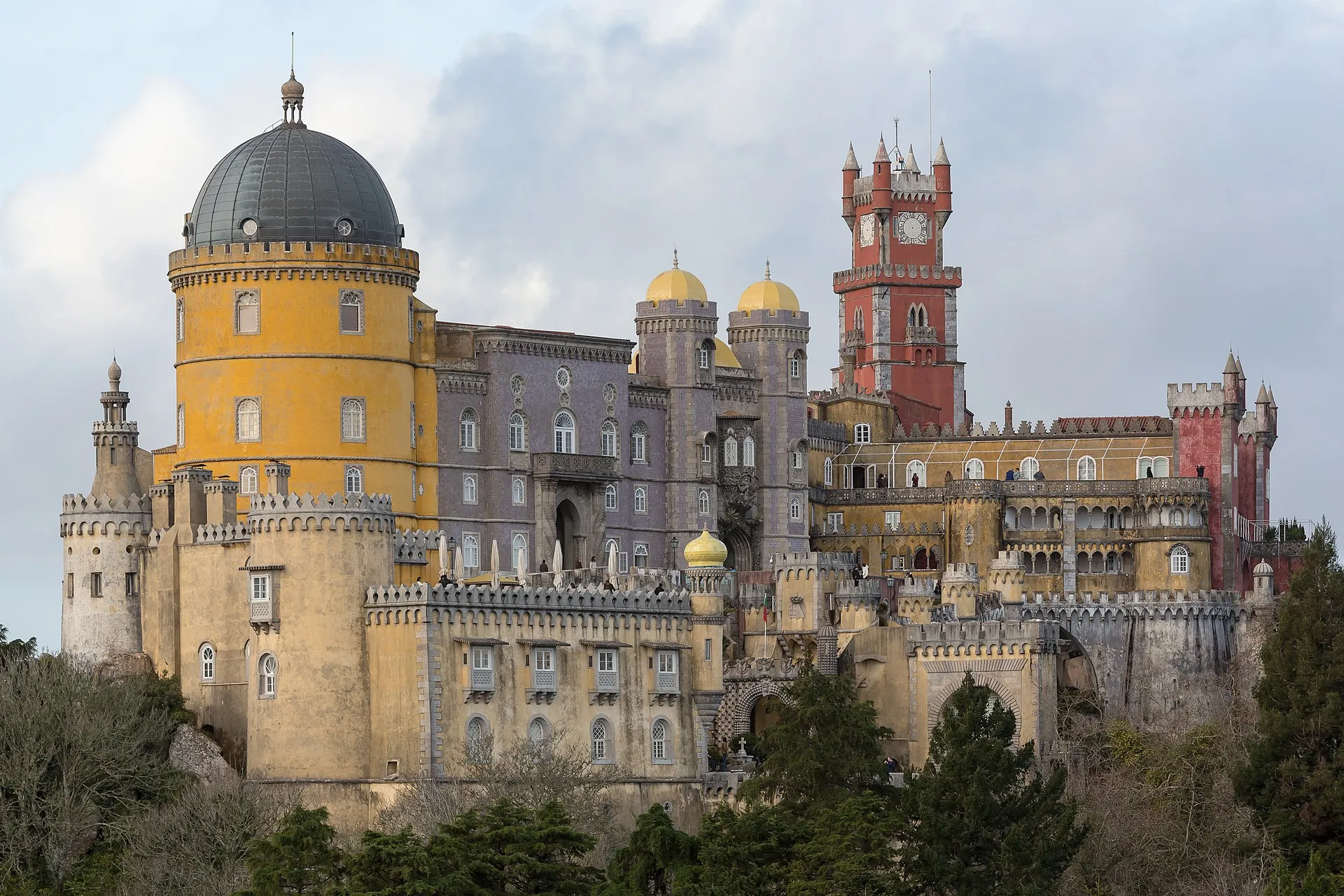
- The clock tower — the red palace's tallest point, added by Ferdinand as much for silhouette and rhythm as for telling the time.
- The chapel and cloister — the yellow, 16th-century monastic core Ferdinand deliberately preserved rather than demolished.
- The ramparts and drawbridge — mock-medieval defences whose only real job is to look magnificent in photographs.
- Pena Park — an engineered forest of specimen trees from Japan, Australia, and North America, threaded with hidden lakes, grottoes, and the fairy-tale Chalet of the Countess of Edla that Ferdinand built for his second wife.
When to Visit
The palace interior opens daily from 9:30 AM to 6:30 PM (last entry 6 PM); the park grounds run slightly longer, 9 AM to 7 PM, so you can linger among the trees after the state rooms close. A few rules of thumb:
- Arrive at opening. Be at the gate by 9 AM and inside the palace by 9:30 — before 11 AM the terraces belong to you; after it, coach groups up from Lisbon fill every parapet.
- Weekday afternoons are the sleeper slot. In shoulder season the crowds thin out sharply once the morning tours retreat downhill.
- Read the fog before you climb. Sintra's Atlantic mist can swallow the summit even when Lisbon is sunny; clear mornings reward you with the ocean from the Queen's Terrace, while overcast days produce the moodiest photographs of towers dissolving into cloud.
- Give it two to three hours. Allow roughly 45 minutes for the state rooms and the rest for the park's lakes, grottoes, and the Chalet of the Countess of Edla.
Admission and Costs
All tickets are sold by Parques de Sintra, and buying online ahead of time is both cheaper and faster than the queue at the gate:
- Palace + Park: €14 — the full experience, state rooms included.
- Park only: €8 — worth it on a foggy day for the 200-hectare engineered forest alone.
- Combined with the Moorish Castle: €19 — a few euros saved if you plan to walk the ramparts too.
- Group guided tour: €35-55 per person (about 2 hours, entry included).
- Private guide: €120-200 for up to six people, typically pairing Pena, the park, and the Moorish Castle across 3-4 hours.
A shuttle bus from the park entrance up to the palace terrace is included in every palace ticket — a genuine mercy given the climb.
The Case for a Guide
Pena looks like a fairy-tale collision of styles, but every detail was Ferdinand II's deliberate statement — a guide turns the building from picturesque chaos into a readable argument about identity, nostalgia, and nineteenth-century power.
- Ferdinand's design philosophy — why a German-born king consort ruling Portugal reached for Moorish arches and Gothic turrets, and the message he was sending about Portuguese history and empire.
- The two-palace boundary — the seam where the yellow 16th-century monastery meets Ferdinand's red addition, and why he chose to preserve the ruined convent instead of levelling it.
- The hidden cistern — the reservoir beneath the main courtyard that kept a hilltop palace with no natural spring supplied with water, and which most visitors walk straight past.
- Reading the wider landscape — how Pena, the Moorish Castle, and the town-centre National Palace were meant to be experienced as a single royal narrative across Sintra.
- Timing the mist — which mornings tend toward fog (dramatic for towers emerging from cloud) versus which offer clear Atlantic views from the Queen's Terrace.
Tips for Visitors
- Start early and climb light. The palace sits at the top of a 20-minute forested climb from the lower gate; wear proper shoes and carry water, or take the included shuttle bus if the ascent is a concern.
- Combine it with the Moorish Castle. The crenellated fortress is a 15-minute walk through the forest — buy the combined ticket and do Pena first, since it is higher and more time-intensive, then descend to the castle.
- Dress for the summit, not the town. The peak runs 5-8 °C cooler than Sintra below; pack a layer even in July.
- Let the fog in. Don't be disappointed when mist wraps the towers — it is exactly the atmosphere Ferdinand's Romantic imagination was chasing.
- Pair it with Regaleira or the coast. With a half-day to spare, add the tunnels of Quinta da Regaleira or continue toward Cabo da Roca, continental Europe's westernmost point.
Frequently Asked Questions
What season showcases Pena Palace at its most spectacular?
May through September provides the clearest skies to appreciate the palace's vivid yellow and red facades against blue sky and green forest, with extended park hours until 7 PM. The palace sits at Sintra's highest point and frequently catches fog even on days when Lisbon is sunny, but summer mornings between 9 and 11 AM typically offer the best visibility. Winter from December through February brings persistent rain and mist that can obscure the hilltop entirely, though some visitors find the towers emerging from swirling cloud hauntingly beautiful.
When can visitors explore Pena Palace?
Palace interior: 9:30 AM-6:30 PM (last entry 6 PM). Park grounds: 9 AM-7 PM (closes later than the palace). Best time: Opening at 9:30 AM — the terraces are nearly empty and fog often still clings to the towers.
Why is a guide helpful for understanding Pena Palace's architecture?
Pena layers Moorish horseshoe arches, Gothic turrets, Manueline twisted stonework and Renaissance domes into a single building, and much of it is invented rather than inherited. A guide untangles which element comes from where, traces the seam between the preserved 16th-century monastery and Ferdinand II's red palace, and explains the Romantic-nationalist argument the Artist King was making by fusing them.
What tips help visitors make the most of a Pena Palace visit?
Arrive at the park gate by 9 AM and reach the palace by 9:30, before the coach groups from Lisbon fill the terraces around 11 AM. The palace sits atop a 20-minute forested climb, so wear proper shoes and carry water, or take the shuttle bus included in your ticket. Pack a layer — the summit runs 5-8 °C cooler than the town below — and don't be disheartened by fog, which only makes the towers more atmospheric.